The Future of Track Racing in the Caribbean
What happens next with the future of Caribbean automotive sports?
NEWS
Irvin Herman
12/22/20254 min read


Motorsports enthusiasts across the Caribbean are grappling with a wave of track closures that threaten the region’s racing culture. Two of the most prominent venues, The Base of St. Lucia and The E. T Joshua Airport "The Tarmac" in St. Vincent, have recently restricted and halted automotive events, citing infrastructure projects and safety concerns respectively.
In St. Lucia, the base has long been a hub of drag racing and automotive community gatherings. However, the construction of a fuel farm has forced authorities to restrict motorsport activities. The track which was once able to cater to quarter mile drag races can now only be used for the “less appealing” eight-mile drags.
Photos By: naut
Meanwhile, in St. Vincent, the government has closed the Tarmac to automotive events as part of its plan to build a new hospital.
To understand the impact, we spoke with organizers, Chad Francis of St. Vincent representing Hyperspeed and John Doe, representing St. Lucia
Q: How are the closures affecting the community? A (SLU): To be honest it is affecting the community in terms of events and participation but so few people were already participating that it is not really noticeable after all the emotion has died down.
A (SVG): I know up to 2024 there were many race cars from St. Vincent coming to compete in St. Lucia and the years before that a much greater number. However, since the closure of the strip only 3 race cars made it to St. Lucia last year from St. Vincent. Usually around this time, racers in St. Vincent would start to prepare, ordering parts etc., but now it isn't as anticipated.
Q: Did the government consult with the community before making these decisions? A (SVG): To me I don’t think this government has any interest in motorsports and what it does for the economy and tourism. There is no relation between them and the current motorsport association. Funny enough, the current Minister of Sports is so out of touch he thought it would be a good idea to put a massive
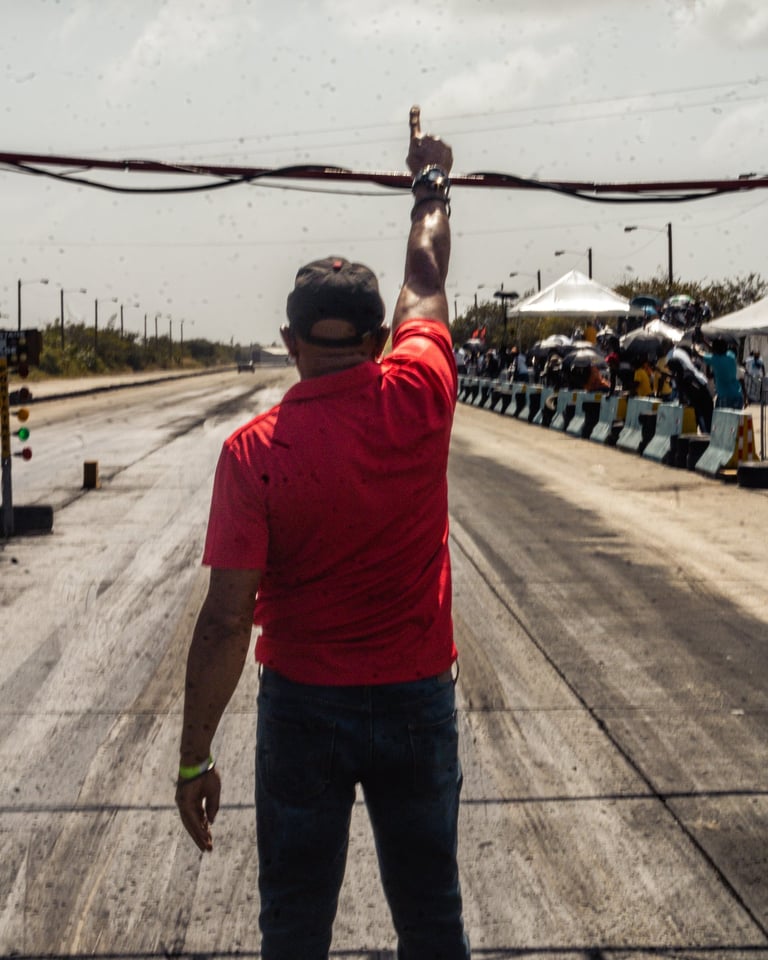
tent for his other ministry dead in the middle of what the racers use as a drag strip. The government is just not interested in motorsport or helping us find a home so that thousands can come to the island and spectate and book hotels and apartments and rentals, and spend their money here to boost the economy like Grenada does with their Pearls race way, or Barbados with their Bushy Park or Antigua with their Northsound international race way – all small islands that attract thousands to their shores for motorsport.
A (SLU): In our situation they did let us know (although not consult) years in advance that they would be taking the base away. The local racers just never organized enough to get the new track completed and now we have only 1/8th but eventually the rest of it will be used as part of airport operations.
Q: Alternatives being considered? A (SLU): There are alternative track locations being looked at as well as trying to save the current one itself. Each option costs money and has its own pros and cons.


A (SVG): St. Vincent being a mountainous island with very limited space on the mainland, it’s becoming increasingly difficult to find a permanent home for motorsport. There are some state lands which I believe would be perfect for a motorsports park in the countryside however, this current motorsport association has not been interested in the bigger picture, added to the fact that the government hasn’t helped one bit. The motorsport community is quickly fading, as enthusiasts have stopped driving their cars and are even selling them to foreigners. However, my club has started a school tour initiative last year where we visited several secondary schools and colleges to foster the new generation of motorsports enthusiasts and hopefully grow the culture.
Q: What will happen with Tarmac Takeover now that the Tarmac is closed? A (SVG): As I said, this may very much be the last motorsports event on the tarmac as it has become virtually impossible. Hopefully the government will at least see the positive impact to the country and collaborate with us to make the independence motorsports event seamless.
Q: What is the future of Racing in Saint Lucia? A (SLU): I strongly believe a track would at least give a place for the youth to grow. Many in their 30s+ are already disenfranchised. A new generation needs to take a more prominent role.
The closures highlight a broader tension between infrastructure development and cultural traditions. While new fuel facilities and hospitals are critical for public safety and health, the absence of racing venues leaves a void for communities that have long celebrated motorsport as a way of life. It must also be known that the motorsport community of St. Lucia is disjointed, and the enthusiasts are only reactive and not proactive as the activism was only done once construction began, despite the fact that the fuel farm project was proposed 7 years ago.
However, the optics remains powerful. Hospitals carry undeniable moral weight, while racetracks are often viewed as recreational. By framing the closure of the Tarmac around the construction of a hospital, the government ensures that public opinion tilts in its favor. Even if organizers and enthusiasts argue for alternative sites or balanced development, the narrative is already set. Racing versus healthcare. This dynamic makes it harder for the motorsport community to rally support without appearing insensitive and raises questions about whether the decision was shaped as much by politics as by planning.
For now, the St. Lucia and St. Vincent racing scenes are at separate but similar crossroads: adapt to new realities and taking racing to the streets or risk fading into memory. The engines may be silent, but the passion of racers and fans remains loud, demanding a future where progress and motorsport can share the road.